There is a nameless weight most of us carry. It is not the weight of effort, though the effort is real. It is the weight of outcomes.
You said the right thing to the right person at the right time. You taught the class for the third year in a row. You sent the text no one answered, prayed the prayer no one witnessed, dropped the seed into ground that showed no sign of life. Weeks passed. Months. And somewhere beneath the surface of ordinary faithfulness, a quiet fear began to grow.
What if nothing is happening? What if I stop and the whole thing falls apart?
We rarely say it this plainly. But it drives us. It shows up as ministry anxiety, exhaustion dressed as dedication, a restlessness that cannot tolerate the silence between the scattering and the harvest. We have confused ourselves with the power source.
Jesus has a word for that.
In Mark 4.26-29, he gives his disciples one of the shortest parables in the Gospels, found only in Mark, four verses long, almost unremarkable on the surface. A man scatters seed. He sleeps. He rises. The seed sprouts and grows. He does not know how. Then one day the grain is ripe and he takes the sickle.
That is the whole story. No villain. No drama. No moment where the farmer’s superior technique saves the crop. Just seed, soil, sleep, and a God who works in the dark.
The Greek of verse 28 hides the key. Mark uses αὐτομάτη (automatē, “by itself, of its own accord, automatically”) to describe how the earth produces grain. The seed contains within itself a power of generation that belongs entirely to the Creator. The farmer did not put it there. He cannot accelerate it. He can only scatter what he has been given and trust the One who designed the seed to do what the seed was made to do.
The farmer still scatters. He still harvests. He is not absent from the field. He is simply not the field’s power source, and that is a distinction the gospel insists we hold.
Isaiah 55 tells us that the word of God will not return to him empty. Romans 10 reminds us that faith comes by hearing. Paul plants, Apollos waters, but God gives the growth. The pattern is consistent across the whole canon. Our job is scattering. God’s job is everything else.
And then the parable turns toward something we might not have expected. The word Mark uses for the farmer rising each morning, ἐγείρω (egeirō, “to rise”), is the standard New Testament verb for resurrection. The whole parable runs on a rhythm of burial and rising, because Jesus is not simply talking about agriculture. He is talking about himself.
The grain of wheat falls into the earth and dies, he says in John 12.24, and bears much fruit. He is the seed. The cross is the burial. Easter is the sprouting. And the harvest of his kingdom, every person gathered to him from every nation, is the fruit of a ground that could not hold him.
This is why you can sleep. The kingdom is not suspended from a thread you are holding. It is held by the risen Christ, and he is not going back to the grave. There is a day coming when the grain will be ripe and the sickle will swing, and that day is set by the Lord of the harvest, not by the quality of our scattering.
The question the parable leaves with us is not, Am I working hard enough? The question is, Am I trusting the One who works?
Those are very different questions. No amount of hard work will overshoot your capacity to trust God. Scatter the word where he has placed you. Sleep when the sun goes down. Rise when it comes up. The harvest is certain. Not one seed scattered in his name is wasted.
~PW 🌮🛶
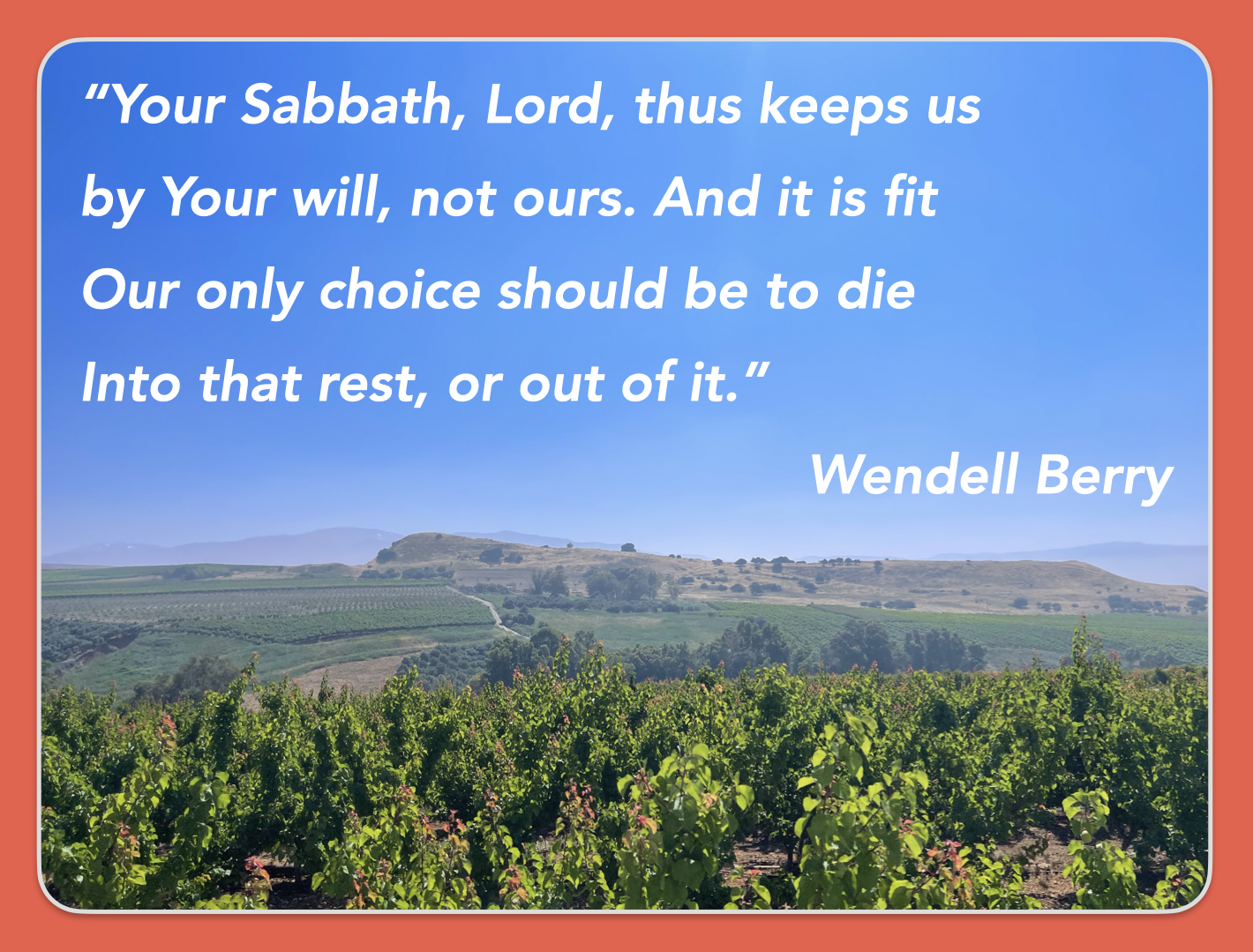
“Your Sabbath, Lord, thus keeps us
by Your will, not ours. And it is fit
Our only choice should be to die
Into that rest, or out of it.”
Berry, Wendell. This Day: Sabbath Poems, 1979 – 2012 (p. 9). (Function). Kindle Edition.
You can find the full sermon transcript, video, and audio here: Mark 4.26-29, The Kingdom Grows


Leave a comment