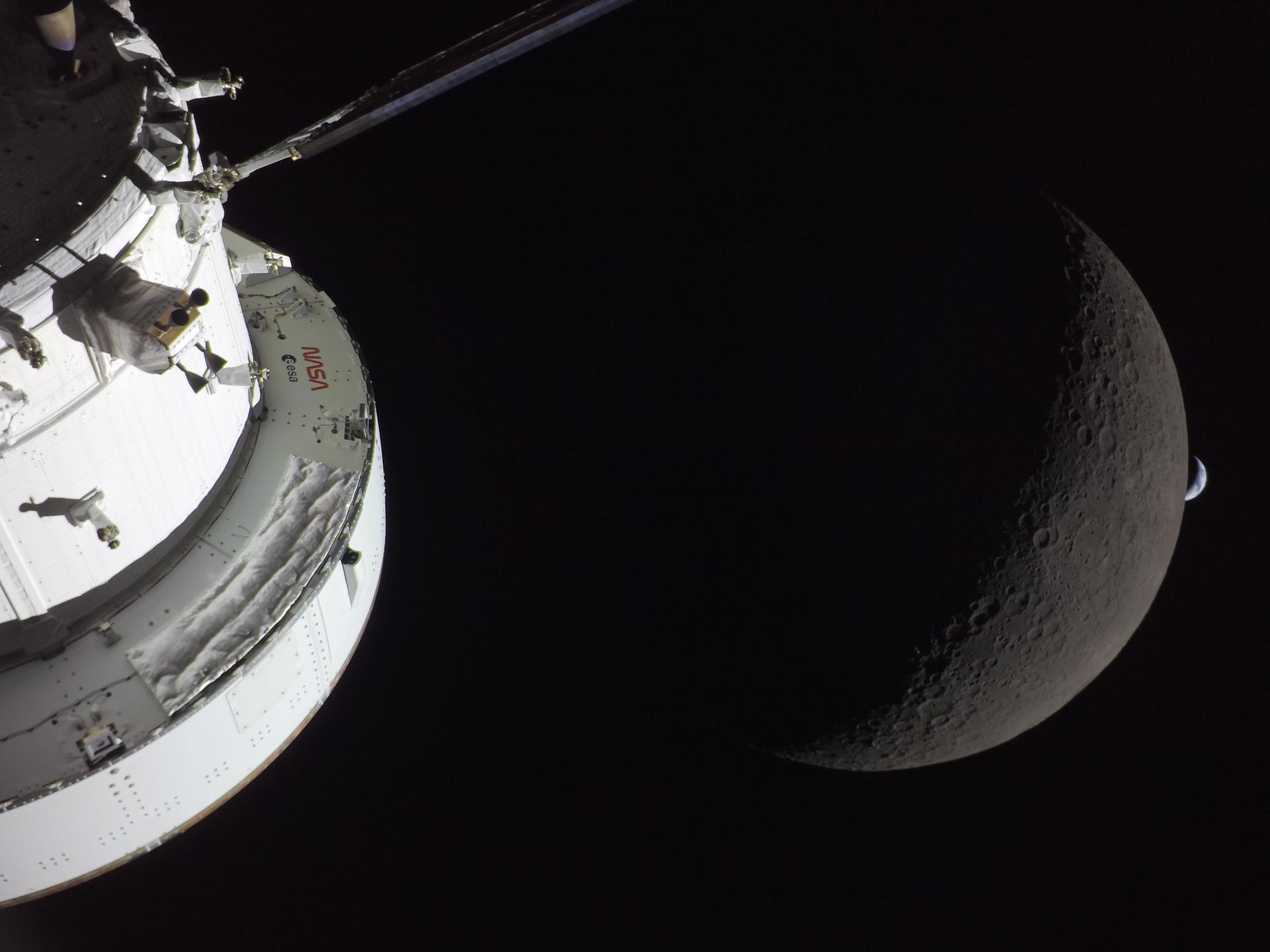
When I was a kid, we covered one wall of my room with a mural of the earth as seen from space. The familiar blue sphere hung in the black, clouds swirling over oceans and continents. At night I would lie in bed and stare at it until my eyes blurred. From that vantage point the world looked small and fiercely cared for, a painted globe held up by an unseen hand.
I did not know it then, but that picture was quietly doing theology. It was teaching me that the earth is not just where we live. It is a gift spoken and sustained by Someone. Job never saw a photograph from space, but when God finally speaks to him out of the whirlwind in Job 38 he does something even more staggering. He gives Job a tour of creation, not as a scientist with diagrams but as a poet who loves his work.
For thirty-seven chapters Job has wrestled in the dark. His world has collapsed. His friends have offered thin explanations. He has cried out for a hearing with God. When the Lord answers, he does not begin with a line-by-line defense of his providence. Instead he starts with a question that sweeps Job out into the cosmos: “Where were you when I laid the foundation of the earth” (Job 38.4 ESV). From that moment to the end of the speech, God is in effect retelling creation.
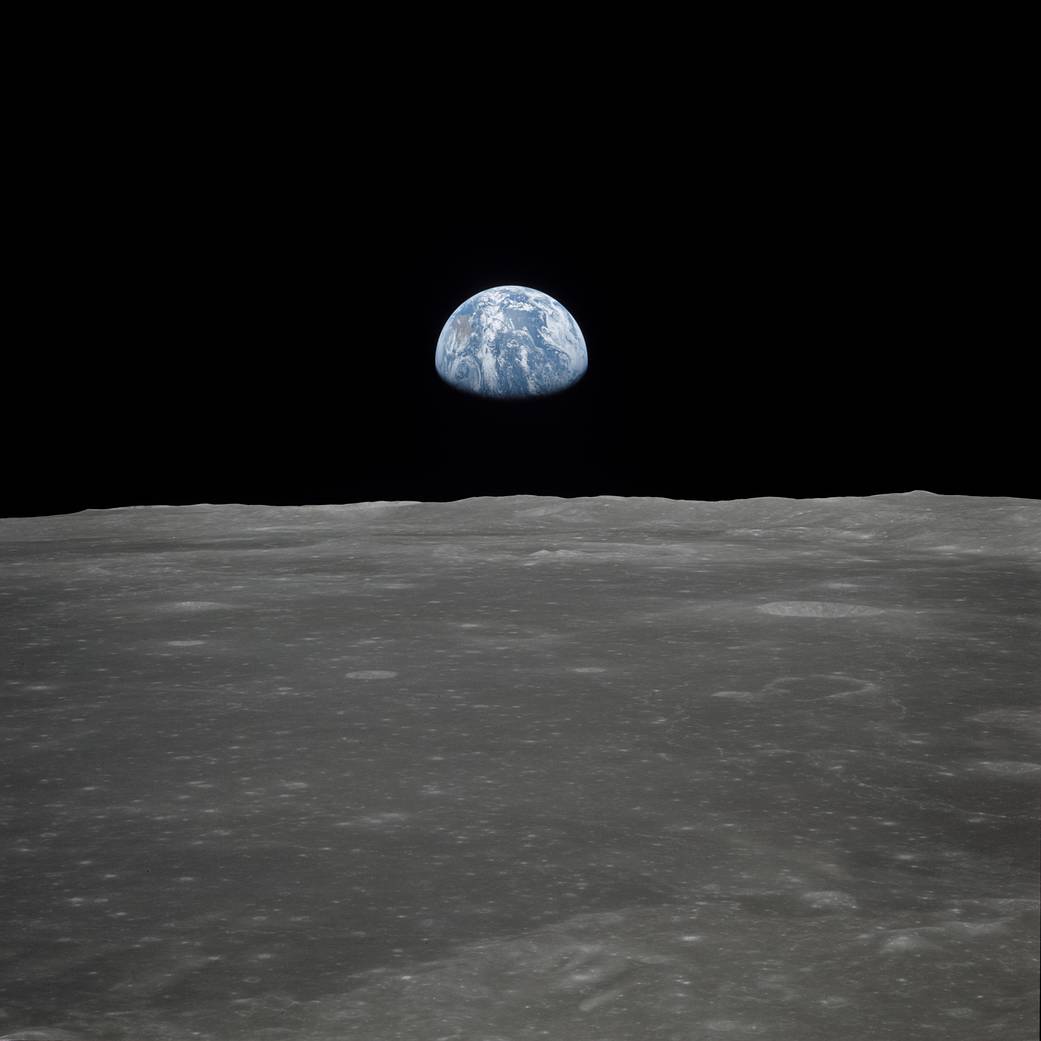
This view of Earth rising over the Moon’s horizon was taken from the Apollo 11 spacecraft. The lunar terrain pictured is in the area of Smyth’s Sea on the nearside. Coordinates of the center of the terrain are 85 degrees east longitude and 3 degrees north latitude.
Genesis 1 gives us an ordered account of the beginning. God speaks. Days unfold. Light and sky and land and life appear in sequence. Job 38 and 39 cover much of the same ground but in a different key. Instead of “And God said” followed by “and it was so,” we hear a cascade of questions. “Who shut in the sea with doors” (Job 38.8). “Have you commanded the morning since your days began, and caused the dawn to know its place” (Job 38.12). “Do you know when the mountain goats give birth” (Job 39.1). The effect is not to confuse Job but to relocate him. God is not only the architect at the beginning. He is the active Lord of a living, ongoing creation.
Job 38.4-11 pictures the earth’s foundations laid and the sea bursting forth like a newborn, “when I made clouds its garment and thick darkness its swaddling band” (Job 38.9). Creation is not a cold engineering project. It is birth and building. “When the morning stars sang together and all the sons of God shouted for joy” (Job 38.7). The world does not just work. It worships.
Then beginning in verse 12 God turns to the daily renewal of that creation. “Have you commanded the morning since your days began, and caused the dawn to know its place” (Job 38.12). Here we meet the striking image in verse 14: “It is changed like clay under the seal, and its features stand out like a garment” (Job 38.14). The “it” is the earth at dawn. In the dark the land is like unmarked clay. When the sun rises at God’s command, light sweeps across the surface like a signet ring pressing into soft wax. Hills and valleys, rivers and roads, fields and cities all emerge in sharp relief as if the world were being freshly stamped and clothed.
This is phenomenological language. God speaks as the world looks from a human vantage point. He is not giving Job a lecture on planetary rotation. He is inviting him to watch the world wake up. From our perspective the earth does turn as the light advances. The poetry presses that experience into service. Every sunrise is like a miniature Day One. God calls light out of darkness and order out of what felt formless.
Why does God retell creation this way to a suffering man?
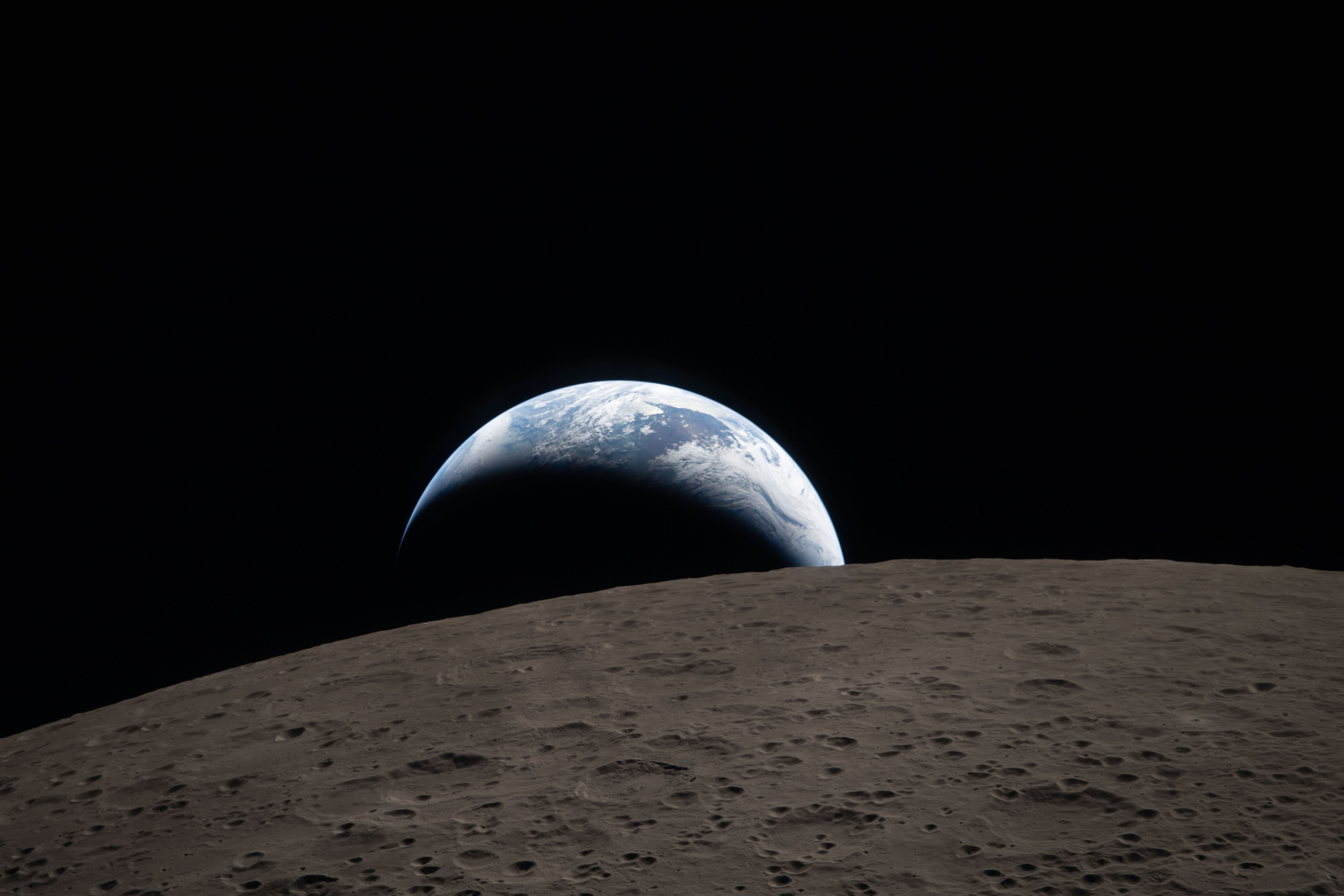
The dark portion of Earth is experiencing nighttime. On Earth’s day side, swirling clouds are visible over the Australia and Oceania region.
In the foreground, Ohm crater has terraced edges and a flat floor interrupted by central peaks. Central peaks form in complex craters when the lunar surface, liquefied on impact, splashes upwards during the crater’s formation.
First, to expose Job’s functional center. In his pain Job has spoken as though the universe should revolve around his case, as though everything depends on answers that satisfy him. Earlier in the book his curse of the day of his birth in chapter 3 plays like an anti-creation, a wish to undo “Let there be light” and sink back into darkness. When God speaks in Job 38 he does not rebuke Job for asking hard questions, but he does overturn Job’s attempt to rewrite the story. The world is not keyed to Job’s suffering. It is keyed to God’s wisdom and care.
Second, God retells creation to retrain Job’s loves. We are shaped not just by what we know but by what we admire and find compelling. Job has stared so long at his pain that it has become his horizon. God does not minimize that pain, but he widens the horizon. He speaks of snow and rain, constellations bound and loosed, mountain goats and ravens sustained. He invites Job to marvel again, to see that the God who orders dawn on the edges of the earth is the same God who has not forgotten him.
Third, this creation tour quietly prepares us for Christ. In Job 38 God’s command of morning exposes the wicked and clothes the earth in light. In the Gospels the true light “which gives light to everyone” comes into the world (John 1.9), and another dawn breaks over a garden tomb. The God who once spoke out of the whirlwind finally speaks in a Son, the One through whom and for whom all things were made. The resurrection is God’s definitive morning, the moment when he stamps history with his own signet and marks out a new creation that cannot be undone.
Many of us move through our days as if the world were a machine we must keep running or a stage on which we must prove ourselves. When suffering comes we feel as though creation itself has turned against us, or as though God has stepped away and left the laws of nature to grind on without care. Job 38 says otherwise. Creation is not just a past event. It is a present testimony to God’s wise, personal rule.
So tomorrow morning, when light begins to creep around the edges of your blinds, you might think of God asking Job, “Have you commanded the morning since your days began” (Job 38.12). You might remember that even if your heart feels like unshaped clay, God is not done pressing his image into you. In Christ he is making you part of his new creation, even when the process feels like darkness and whirlwind.
You do not have to be the center of the universe. You do not have to hold everything together. The One who laid the foundation of the earth and who daily stamps it with light holds you as well. Let the sunrise preach that to your heart again and again until his glory becomes your joy.
~PW 🌮🛶
 Phillip W. Martin
Leave a comment