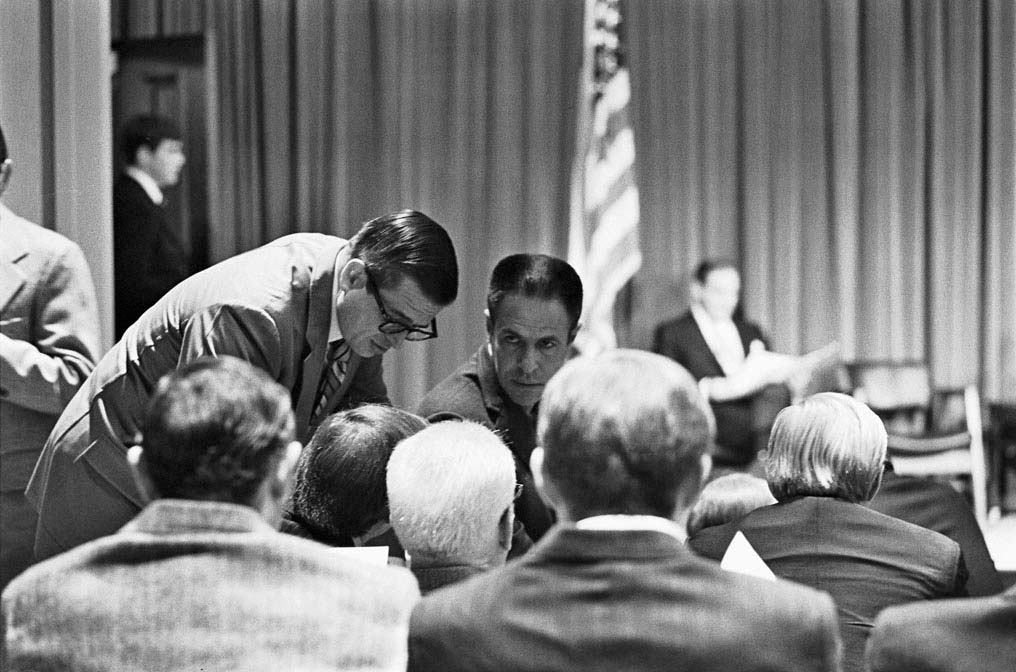
Photo: Jack Kightlinger / White House Photo / Nixon Presidential Library and Museum / NARA
“I know the resurrection is a fact, and Watergate proved it to me. How? Because twelve men testified they had seen Jesus raised from the dead, and then they proclaimed that for forty years, never once denying it. Every one of them was beaten, tortured, stoned, and put in prison. They would not have endured that if it weren’t true.” ~ Chuck Colson
Maybe you’ve never said it out loud. But somewhere in a quiet moment, driving home from church or lying awake at 2 a.m., the thought surfaces. What if the whole thing is a story? What if the first Christians simply needed something to believe in, and the resurrection gave them that? What if it was a well-meaning fabrication that got out of hand?
That question deserves a real answer.
Chuck Colson knew something about cover-ups from the inside. As Richard Nixon’s Special Counsel, he was one of the most powerful political operatives in the country. He later admitted he would have done nearly anything to protect the president. When Watergate unraveled, he watched it happen in real time: twelve men, highly motivated, politically sophisticated, with every reason to hold the line. They couldn’t do it. The cover-up collapsed in weeks.
That observation never left him. Because while those men had power, money, and political survival at stake, the apostles had none of that. They had everything to lose. And yet the movement’s earliest witnesses and leaders maintained their testimony through decades of hardship. The sources preserve no counter-tradition in which any central witness confessed the resurrection was knowingly invented.
The historical record rewards careful handling here. The earliest witnesses were threatened, beaten, imprisoned, and in some cases executed. The evidence is strongest for a handful of the apostolic leaders. James the brother of John was killed by Herod’s sword (Acts 12.2, in Scripture itself). James the brother of Jesus was stoned by order of the high priest, attested by the Jewish historian Josephus. Clement of Rome, writing near the end of the first century, says Peter endured many labors and suffered martyrdom. What the earliest sources suggest is not that every detail is equally documented, but that the central witnesses were remembered as suffering for their testimony, not retracting it.
People die for things they believe to be true. History is full of martyrs for mistaken causes. But organized, decades-long suffering for something you know to be a deliberate lie is a different category of human behavior. What historians like Michael Licona consistently argue is that shortly after Jesus’ death, a number of disciples had experiences they were convinced were appearances of the risen Jesus. They sincerely believed it. That is the point Colson’s argument presses hard, and it presses it well.
The argument does one thing, and Colson was precise about what that is: it dismantles the conspiracy theory, the claim that the disciples knowingly fabricated the resurrection and maintained that fabrication for life. It doesn’t answer every question a skeptic might raise. It was never meant to.
But this is where the argument opens into something more important.
John closes his account of the resurrection with a scene worth reading slowly. Thomas refuses to believe until he can touch the wounds himself (John 20.24-25). He doesn’t waver quietly. He states a condition. And Jesus doesn’t respond with a lecture. He shows up, offers exactly what Thomas demanded, and Thomas confesses: “My Lord and my God” (John 20.28).
Then John explains the purpose of everything he has written: “These are written so that you may believe that Jesus is the Christ, the Son of God, and that by believing you may have life in his name” (John 20.31). The goal was never the argument. It was life.
Because the real obstacle is rarely a shortage of information. Behind most doubt there is something harder: an unwillingness to trust, a wound that makes surrender feel reckless, a life quietly ordered around other sources of certainty and worth. The historical case for the resurrection is strong. But evidence alone cannot move a closed heart. Only Christ can do that.
Colson was not argued into faith. He was converted in a driveway, unable to drive, sobbing words he didn’t know how to form. The evidence helped him see that faith was reasonable. But what undid him was an encounter.
Jesus offered Thomas his wounds. He can offer you the same.
~PW 🌮🛶
For further reading: Sean McDowell, The Fate of the Apostles; Michael Licona, The Resurrection of Jesus; Chuck Colson’s account at BreakPoint.org.


Leave a comment