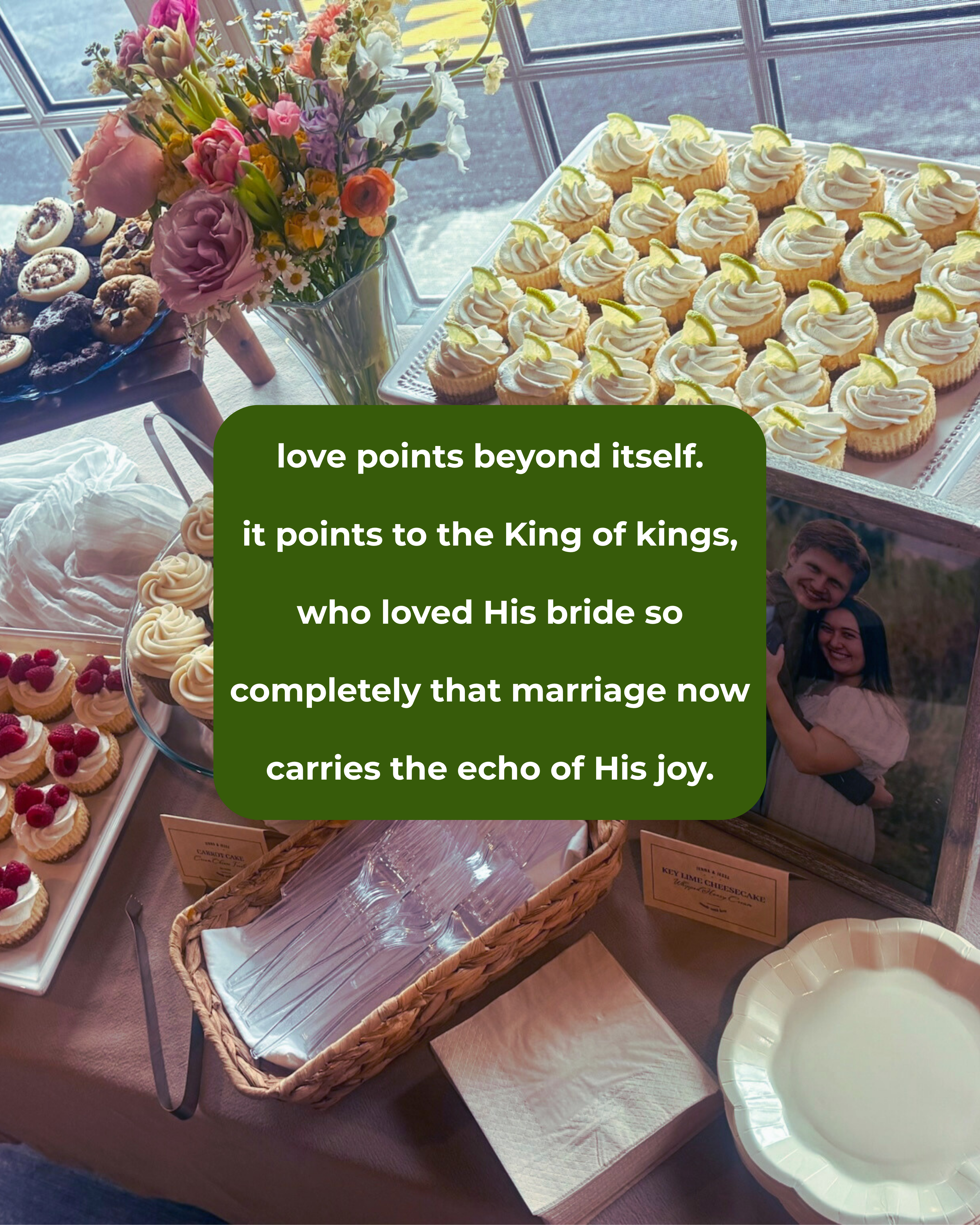
This week, I had the absolute joy of performing the wedding ceremony for my son Jesse and his bride Jenna. I have preached funerals, led worship services through grief, and stood at bedsides in the middle of the night. But there is something particular about standing before friends and family to officiate a covenant for your own child. You are simultaneously the preacher and the father. The theological task and the personal weight are folded into one another in a way that does not separate easily.
That doubled vantage point shaped how I prepared the remarks. Marriage, as Scripture presents it, lives in three tenses. Past, present, and future. Each tense is anchored in a different text. Each carries a different theological register. And together they tell a story large enough to hold two people who are choosing, before God and witnesses, to spend their lives together.
Marriage in the Past Tense:
The story of marriage begins before brokenness does. In the opening pages of Scripture, God surveys His creation and says, for the very first time, “It is not good” (Genesis 2.18). Not because something had gone wrong, but because something was not yet complete.
This is theologically crucial. The “not good” of Genesis 2.18 is one of the most significant phrases in the creation narrative. It does not signal failure or disorder. It signals incompleteness.1 God has surveyed a world He has called good at every prior turn, and now for the first time He names an absence. Marriage is presented not as a remedy for sin, but as the completion of a design. It predates the Fall entirely. It belongs to the order of creation, not the order of redemption.
So God forms a partner. Equal. Complementary. Irreplaceable. And He brings her to the man.
The Hebrew word for “helper,” עֵזֶר (ʿēzer), carries no subordination of dignity. The same word is used in the Psalms of God Himself as Israel’s help (Psalm 121.2).2 The point is complementarity, not hierarchy of worth. The woman is presented as one who corresponds to the man, who matches him in dignity and personhood, who completes what was incomplete.
The man’s response is the first recorded poem in Scripture. He sees her and breaks into song:
“This at last is bone of my bones and flesh of my flesh; she shall be called Woman, because she was taken out of Man.” (Genesis 2.23, ESV).
The Hebrew הַפַּעַם (happaʿam, “at last”) carries a sense of recognition and completion.3 He names what he sees. He sings before he reasons. This is worth pausing over: the first human response to marriage is aesthetic and lyrical, not contractual. Marriage does not begin with negotiation. It begins with wonder.
Then God announces the pattern:
“Therefore a man shall leave his father and his mother and hold fast to his wife, and they shall become one flesh” (Genesis 2.24, ESV).
Notice what that means. The leaving is not abandonment. It is the formation of a new primary loyalty, the establishment of a new household under God’s care. The one-flesh union is comprehensive, encompassing physical, social, covenantal, and spiritual joining.4 This is not a merger of resources. It is the merging of lives, hearts, and futures.
Marriage in the past tense tells us that marriage is good. Not because of what two people bring to it, but because God designed it. It tells us that leaving and cleaving is not abandoning your family; it is an act of courage. And it tells us that the one-flesh union is not incidental to marriage. It is constitutive of it.
Here is what makes any wedding day so remarkable: the God who designed marriage, who declared it good before anything had gone wrong, is present as the covenant is made. The love two people feel for one another is real and it is beautiful. And the reason it will endure, through fatigue, through grief, through every ordinary Tuesday, is that His love will hold what theirs cannot. His design is what makes the moment sacred.
Marriage in the Present Tense:
But God did not leave marriage in the garden. He carried it forward, through the Fall, through the cross, through resurrection, and filled it with something the garden never had or needed: grace.
Marriage in the present tense is where the gospel comes alive between two people. It is one of the most joyful and generous gifts God gives His people. Husbands and wives will laugh more than they expect. They will be known more deeply than they thought possible. And they will discover places where they fall short.
Covenant is built for that. You do not have to be perfect for this to work. You have to be faithful.
Marriage in the present tense means you are always, together, in the grace-filled work of confessing, forgiving, and drawing near again. And each time you do, your love does not weaken. It deepens.
The Pattern of Ephesians 5
The Apostle Paul gives us the pattern in Ephesians 5.25–33. Husbands are called to love their wives “as Christ loved the church.” Christ’s love was not a feeling. It was a commitment that moved toward the cross, self-giving, self-sacrificing, steady when it was costly.
Paul’s instruction is the most theologically dense passage in the New Testament on marriage. The governing logic is analogy: the husband is to love his wife as Christ loved the church (v. 25). But this is not merely an example. It is a typological pattern. The marriage relationship does not merely illustrate the Christ-church relationship; it participates in it, making it visible.5
The word Paul uses for love here is agape, the self-giving love defined by Christ’s sacrifice. Paul is not describing romantic affinity but covenantal, volitional commitment. The phrase “as Christ loved the church and gave himself up for her” (v. 25) sets cruciform sacrifice as the paradigm. The husband’s love is to be cross-shaped.
Critically, Paul does not leave the love at the cross. The entire Ephesians 1–2 framework presupposes resurrection and exaltation. Christ who gave Himself up is also the one seated at the right hand in the heavenly places (1.20).6 The call to sacrificial love is not a call to mere endurance but to empowered, resurrection-grounded faithfulness.
This is the pattern set before every husband: not authority for its own sake, but love that serves, that sacrifices, that stays, and that rises. And Paul shows both husband and wife the mystery: “This mystery is profound, and I am saying that it refers to Christ and the church” (v. 32). Your marriage is a picture of the gospel. In marriage you rehearse the gospel every day, delight, gratitude, confession, forgiveness, grace, and the steady choice to keep showing up with joy.
The love that will bind a husband and wife together is not anchored in emotion. It is anchored in the cross.
The Threefold Cord of Ecclesiastes 4
“Two are better than one, because they have a good reward for their toil. For if they fall, one will lift up his fellow... And though a man might prevail against one who is alone, two will withstand him; a threefold cord is not quickly broken” (Ecclesiastes 4.9–12).
Qohelet observes the practical superiority of companionship: two are better than one because their labor yields better return, because one can help the other when he falls, because they can warm each other, because two can withstand what one cannot.7 The threefold cord of verse 12 is an organic conclusion: if two are better than one, then three, at the structural level, is strongest of all.
The theological application to marriage is typological rather than strictly exegetical. Qohelet is not discussing marriage specifically, and the third strand is not explicitly identified as God. But the typological move is defensible: Christian marriage is the place where two people invite the God of covenant to be the binding third presence. This is exactly what Paul’s mystery language implies, that the marriage which reflects the Christ-church union is one in which Christ is actively present.
Many couples braid two strands and wonder why it feels fragile. The invitation of Scripture is to invite God to be the third strand. Pray together. Read Scripture together. Worship together. Open your home. Forgive quickly. Do not let resentment take root.
When storms come, and they will come, the cord braided with God’s presence will hold. And in the quiet days, the ordinary mornings, the shared meals, the laughter no one else hears, that same cord will be the source of the deepest joy.
Marriage in the Future Tense:
But marriage does not only have a past and a present. It has a future. Not only the temporal future, the house, the years, the children, the grandchildren. But the future. The future toward which all of history is moving.
Hear the words of Revelation 19.6–7:
“Then I heard what seemed to be the voice of a great multitude, like the roar of many waters and like the sound of mighty peals of thunder, crying out, ‘Hallelujah! For the Lord our God the Almighty reigns. Let us rejoice and exult and give him the glory, for the marriage of the Lamb has come, and his bride has made herself ready.’”
This is the consummation scene of the entire biblical marriage typology. John hears a voice like a great multitude, like the roar of many waters, like mighty thunder, crying “Hallelujah!” because the marriage of the Lamb has come, and His bride has made herself ready (v. 7).8 This is the fulfillment of what human marriage has been pointing toward since Genesis 2.
The bride’s readiness in verse 8 is defined by “fine linen, bright and pure,” which is identified as “the righteous deeds of the saints.” But critically, the linen is given to her (edothe, a passive verb implying divine bestowal). The bride does not clothe herself by her own merit. The readiness of the bride is the righteousness of Christ imputed and expressed in transformed lives.9 The eschatological marriage is not earned by the bride. It is received.
What every Christian couple does on their wedding day, this covenant, these vows, this union, is a signpost pointing to that day. Their marriage is a living parable. A preview of the marriage that stands at the end of all things: Christ and His bride, the church, fully united at last.
That is the marriage for which every believer waits. The fulfillment of all that Jesus has accomplished. His life given. His victory won. His resurrection declared. His promise kept. He is coming again to receive His bride to Himself.
That is why we celebrate at weddings. The couple’s love matters. It is real. It will grow. And here is the wonder: their love points beyond itself. It points to the King of kings, who loved His bride so completely that their marriage now carries the echo of His joy.
The imagery of a wedding feast, which runs throughout Jesus’s parables (Matthew 22; 25; Luke 14), here reaches its fulfillment. The Lamb who was slain (Revelation 5.6, 12) is now the Lamb who reigns and receives His bride. Sacrifice and triumph, crucifixion and coronation, are held together in a single figure.10
The angel’s statement in verse 9, “Blessed are those who are invited to the marriage supper of the Lamb,” uses the language of beatitude familiar from the Sermon on the Mount. The eschatological future is framed as blessing, as abundance, as feast, not as abstract judgment or bare survival.
Holding the Three Tenses Together
Hold these three tenses in your hands as you build a life together.
In the past, remember the God who designed marriage, who declared it good from the very beginning. Marriage is not an accident. It is not a cultural construct. It is a divine design, rooted in the very order of creation.
In the present, trust the God who meets you with grace, who gives you the joy of being fully known, and who weaves Himself into your marriage as the third and strongest strand. You will rehearse the gospel every day, delight, gratitude, confession, forgiveness, grace, and the persistence to keep showing up with joy. The love that will sustain you is not anchored in emotion. It is anchored in the cross and vindicated in the resurrection.
In the future, fix your eyes on the marriage that is coming, the one your marriage points toward, and let the hope of that day fill you with joy in every season, the beautiful ones and the hard ones alike. Your marriage is not the ultimate reality. It is a preview of it. And that makes it more meaningful, not less.
Your past holds justification; He has declared you His. On your wedding day, a declaration is made over you, that you belong to one another. Your present holds sanctification; by His Spirit, He is conforming you to the image of Christ, and from that day forward, that work takes place in you together, as one flesh. Your future holds glorification, the fullness of joy, the final reality, the wedding feast that has no end.
What therefore God has joined together, let not man separate.
May every Christian home be a place of grace, truth, and joy. May it be a living parable of the gospel. And may the God who designed marriage, who sustains marriage, and who stands as the goal of all marriage, be glorified in ours.
~PW 🌮🛶
References:
- Wenham, Gordon J. Word Biblical Commentary: Genesis 1–15. Waco: Word Books, 1987. ↩︎
- Hamilton, Victor P. The Book of Genesis, Chapters 1–17. NICOT. Grand Rapids: Eerdmans, 1990. ↩︎
- Wenham, Genesis 1–15. ↩︎
- Sailhamer, John H. “Genesis.” In The Expositor’s Bible Commentary, vol. 2. Grand Rapids: Zondervan, 1990. ↩︎
- Lincoln, Andrew T . Ephesians. Word Biblical Commentary 42. Dallas: Word, 1990. ↩︎
- Thielman, Frank. Ephesians. BECNT . Grand Rapids: Baker Academic, 2010. ↩︎
- Longman, Tremper, III. The Book of Ecclesiastes. NICOT. Grand Rapids: Eerdmans, 1998. ↩︎
- Beale, G. K. The Book of Revelation. NIGTC. Grand Rapids: Eerdmans, 1999. ↩︎
- Osborne, Grant R. Revelation. BECNT . Grand Rapids: Baker Academic, 2002. ↩︎
- Bauckham, Richard. The Theology of the Book of Revelation. Cambridge: Cambridge University Press, 199. ↩︎
 Phillip W. Martin
Leave a comment