We prefer our saviors at a distance. Close enough to help, far enough not to expose. Scripture offers no such Messiah. It gives us one who comes near and stays.
There is no Golgotha if there is no Bethlehem.
The cross does not appear suddenly at the end of Jesus’ life like a tragic accident. It grows organically out of the incarnation itself. The manner of His death is already written into the manner of His coming.
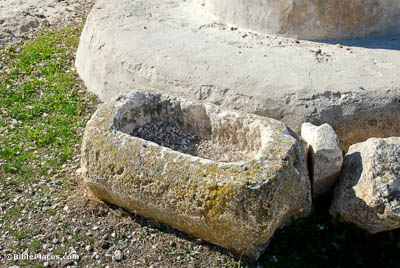
Luke tells us that Mary laid her firstborn son in a manger, Luke 2.7. A manger is a feeding trough for livestock, typically carved from stone or hollowed from wood. The Son of David enters the world in poverty, vulnerability, and dependence. This is not a disguise. It is disclosure.
John names the event with deliberate weight. “The Word became flesh and tabernacled among us,” John 1.14. Flesh is not neutral. In Scripture, it names mortality, weakness, and exposure to death. N. T. Wright notes that incarnation is not God pretending to be human, but God committing Himself fully to the human condition, including its suffering and death. The incarnation already leans toward the cross.
The prophets prepared Israel for this pattern. Micah speaks of a ruler from Bethlehem whose origins are “from ancient days,” Micah 5.2. Eternity steps into obscurity. Isaiah describes a servant who is bruised and afflicted, yet faithful, Isaiah 42.1–4; 53.3–5. The suffering servant does not interrupt the messianic story. He completes it.
The Gospels confirm this trajectory. Jesus consistently chooses the downward way. He is born among the poor, lives without land or title, eats with sinners, touches the unclean. He speaks of His death not as defeat but as vocation. “The Son of Man came not to be served but to serve, and to give His life as a ransom for many,” Mark 10.45. The one laid in a feeding trough will offer Himself as bread for the world.
Paul gives the church language to hold the whole story together. Christ Jesus, though existing in the form of God, did not regard equality with God as something to be exploited, but emptied Himself, taking the form of a servant, Philippians 2.6–7. The self-giving life of Jesus is not merely exemplary but participatory. God’s identity is cruciform.
Golgotha sharpens what Bethlehem began. The place of the skull is not a contradiction of the incarnation. It is its fulfillment. Jesus shared in flesh and blood so that through death He might destroy the one who has the power of death, Hebrews 2.14. He does not save humanity from the outside. He saves by entering fully into its plight.
This matters for our fears and our pride. We often imagine strength as distance and control. God reveals strength as nearness and faithfulness. We imagine salvation as escape. God brings salvation through endurance and trust. Bethlehem teaches us that God is not ashamed of our weakness. Golgotha teaches us that He is willing to carry it to the end.
The crucifixion cannot be understood apart from the incarnation. The cross is not simply what Jesus did. It is who God is for us. The manger already points toward the nails.
Holding these truths together reshapes worship. His birth without the cross becomes nostalgia. The cross without his birth becomes abstraction. Together they tell the truth about love.
Love comes close.
Love stays.
Love bears the cost of reconciliation.
The child laid in Bethlehem’s manger is the Lord who walked to Golgotha, and He still meets us there with saving love.
~PW 🌮🛶
 Phillip W. Martin
Leave a comment