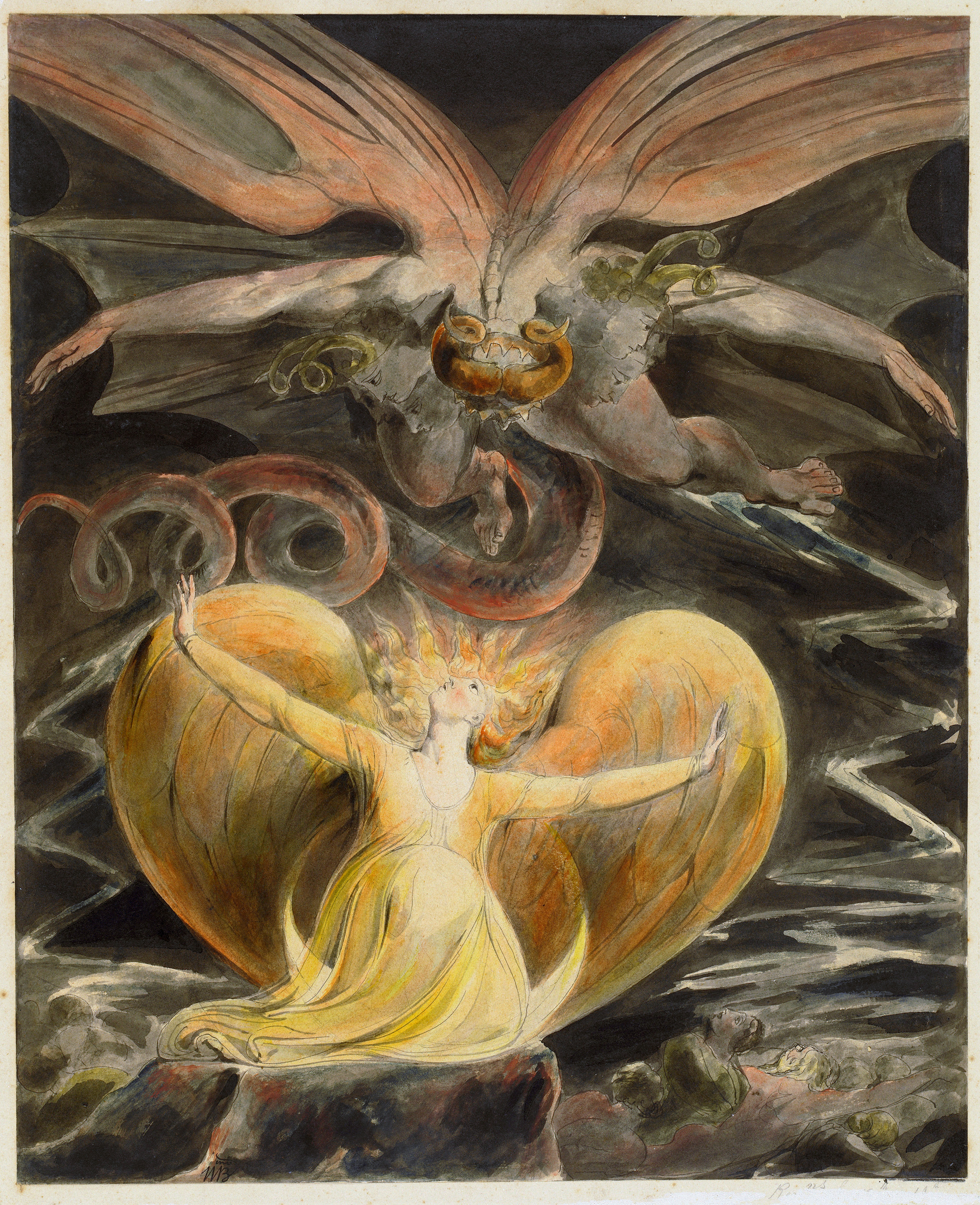
Blake’s Great Red Dragon captures in visual form what Lewis described in words: every soul is destined to become either radiant with glory or terrifying in corruption.
The world feels heavy these days. Violence fills the headlines, division hardens conversations, and even small disagreements seem to spiral into open conflict. For disciples of Jesus, the question presses in: how do we live in a world where good and evil are not just abstract ideas but active forces colliding all around us?
The Bible does not pretend otherwise. From the very beginning, the story shows good and evil in sharp contrast. Cain kills Abel, and his brother’s blood cries out from the ground. The psalmist looks at the chaos of nations and asks why people rage against God’s ways. Paul names what is happening behind it all: we do not wrestle against flesh and blood but against cosmic powers of darkness. Evil is not just personal sin; it moves through societies, systems, and powers.
C. S. Lewis put it memorably. He said the world is “enemy-occupied territory.” To be a disciple, then, is to join the rightful King who has landed behind enemy lines, quietly but decisively at work. Discipleship is not passive. It is an act of allegiance, living as resistance to the darkness.
The problem is that evil often does not look evil. Lewis warned that pride can wear the mask of virtue and hatred can dress itself up as justice. Paul said Satan appears as an angel of light. That means discernment is crucial. What looks like progress may in fact be corruption. What sounds righteous may actually be rebellion.
But here is the good news: evil is not equal to good. Augustine said that evil does not create; it corrupts. It is always a distortion of something God made. That is why disciples can face the worst without despair. Even the cross, the darkest moment in history, was turned into redemption.
I was reminded of this recently in a simple, ordinary conversation. I was talking with “Bug,” a self-declared nonbinary person who is biologically female, married to a man, and uses plural pronouns. I do not know what has brought them to that point. But I do know that cruelty would not help. I do not have to compromise conviction to treat them with respect. Every human being, whatever their story, bears the mark of the Creator. That truth shapes the way disciples respond to those they do not fully understand.
So what does it look like to live as disciples in a tumultuous world? The Bible gives us a rhythm.
- First, lament. Refuse to accept evil as normal. Cry out, “How long, O Lord?” Lament is not despair; it is faith that God will act.
- Second, hope. The resurrection declares that death and evil are already defeated, even if not yet erased.
- Third, act. Paul told the Romans not to be overcome by evil but to overcome evil with good. That is not naïve optimism but the strategy of the kingdom.
Lewis once said that every person we meet will one day become either a creature we might be tempted to worship or one we would recoil from in horror. That vision clarifies what is at stake. Every choice, every refusal to repay evil with evil, is part of God’s eternal work.
The world may be turbulent, but the call of discipleship has not changed. Evil is real, but it is not ultimate. In Christ, we lament the darkness without despair and walk as children of light.
~PW 🌮🛶
Lewis, C. S. (2001). The weight of glory. HarperOne. (Original work published 1949)
 Phillip W. Martin
Leave a comment