
Tel es-Safi/Gath (תל צפית), also known as Tel Tsafit, is one of the many lesser-traveled sites in the heart of the Jezreel Valley. It offers a rich tapestry of ancient history, from its early settlement to its role in various biblical events. There is widespread certainty that it is the site of the ancient city of Gath. It is in the Shephelah region, also known as the Judean foothills. This area lies between the coastal plain and the Judean mountains, making it a strategic location in ancient times due to its proximity to major trade routes and fertile agricultural land. Tel es-Safi is approximately 25 kilometers east of Ashkelon and 35 kilometers west of Jerusalem.
Biblical Events Associated with Tel es-Safi:

- King Saul’s Campaign: The area surrounding Tel es-Safi is considered part of King Saul’s territory during his reign. His campaigns against the Philistines likely included movements and battles near this strategic location.
- Goliath’s Hometown: According to the Bible, Gath was the hometown of Goliath, the giant warrior defeated by the young David (1 Samuel 17). This association has made Tel es-Safi a focal point for understanding Philistine culture and its interactions with the Judahites.
- Capture by King Hazael: The Bible records that the Aramean king Hazael captured Gath (2 Kings 12:17), an event corroborated by archaeological evidence of destruction layers at the site. King Hazael’s destruction permanently ended the Philistine habitation of the site. Besides the complete destruction, the most significant archaeological evidence of that event is a massive siege works trench system that encircled the entire city. It is still clearly visible from atop the Tel or in the air. The destruction was so complete that the site lay abandoned for some 15 or 20 years and left a visible layer of windblown silt in the strata across the entire site (referenced in Amos 6:2). Archaeologists uncovered skeletons still lying in the excavated ruins, indicating that no one had returned to bury the bodies. Interestingly, when the destroyed and abandoned site was finally re-inhabited, it was re-established as a city of Judah. The new settlement was much smaller than its Philistine predecessor and lasted only a short time.
Timeline of Discoveries and Excavations at Tel es-Safi:
- 1875: Claude Reignier Conder visited the site and was impressed with its height and position in the landscape but not by the “insolent peasants.”
- 1899: The first excavations at the site began when Frederick J. Bliss and R. A. Stewart Macalister worked for three seasons on behalf of the Palestine Exploration Fund.
- 1950s-1960s: Initial surveys conducted by Israeli archaeologists identified Tel es-Safi as a site of interest due to its strategic location and surface finds of pottery shards and other artifacts. Moshe Dayan conducted illegal digs at Tel es-Safi and other sites during this period.
- 1980s-1990s: Systematic excavations began, uncovering significant remains from various periods, including Canaanite, Judahite, and later occupations. These digs revealed the site’s importance as a fortified settlement and its role in regional trade networks.
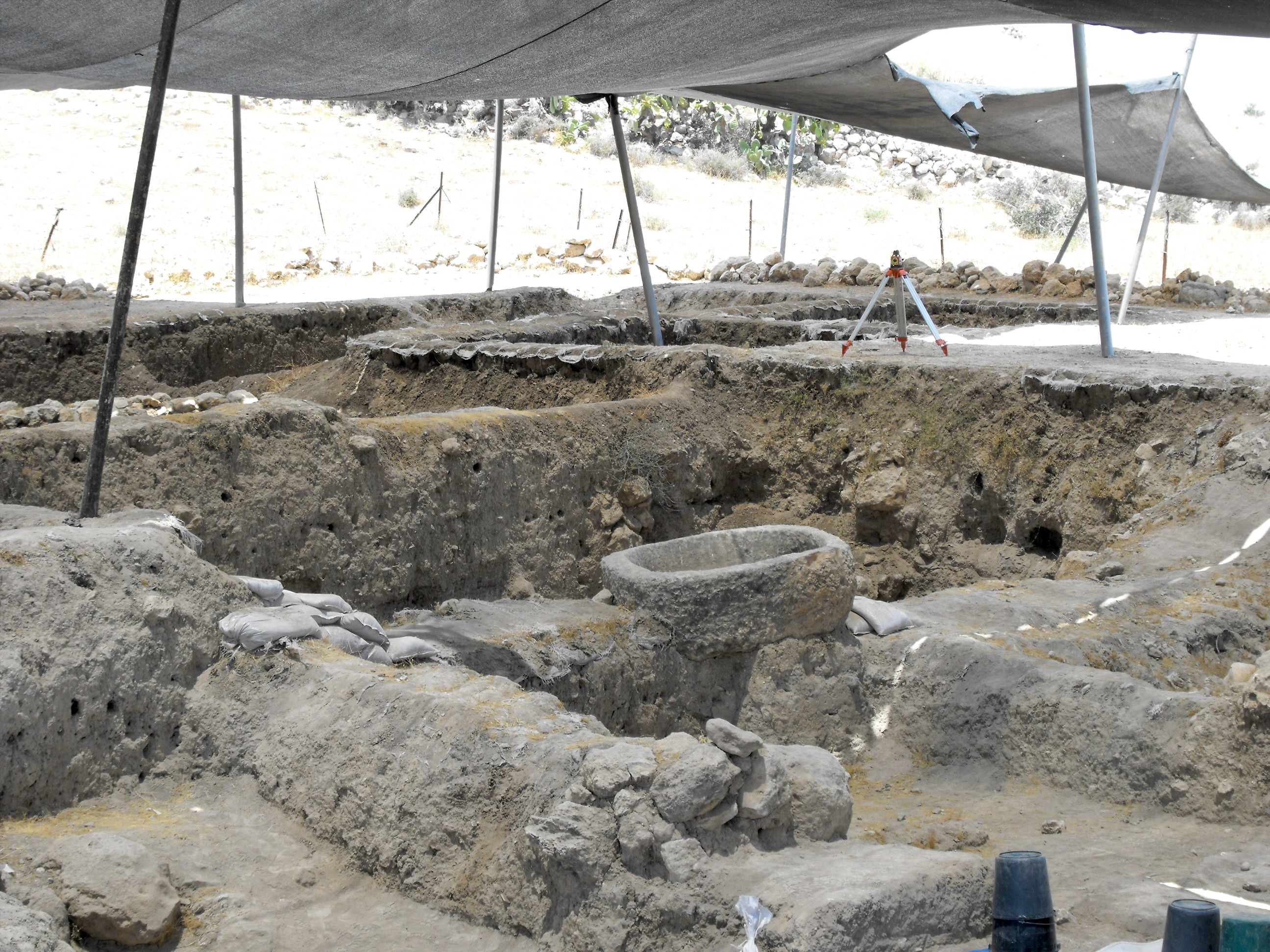
- 1996-Present: The Tel es-Safi Archaeological Project, led by Aren Maeir, has excavated the site since 1996. Recent excavations have focused on uncovering more details about Tel es-Safi’s ancient inhabitants’ daily lives, economy, and religious practices. Advanced archaeological techniques, including ground-penetrating radar and 3D mapping, have been employed to explore the site’s complex stratigraphy. The official excavation project recently concluded, and the archaeological team is now in its publishing phase. However, a minimal excavation was just completed, probably to clarify specific questions during the publication process.
Other Noteworthy Details:

- Archaeological Significance:
- Extensive Excavations: Ongoing excavations at Tel es-Safi have uncovered many artifacts and structures that shed light on the city’s history from the Early Bronze Age through the Iron Age and beyond.
- Discovery of a Massive City Gate: One of the most impressive finds is the massive city gate, believed to be from the time of the Philistines. This gate underscores the city’s importance and its formidable defensive capabilities.
- Cultural Interactions:
- Philistine and Judahite Relations: The finds at Tel es-Safi provide insights into the complex relationships between the Philistines and their Judahite neighbors. Artifacts show a blend of Philistine, Canaanite, and Judahite cultural influences.
- Imported Goods: The discovery of imported goods, such as pottery and luxury items, indicates that Tel es-Safi was part of extensive trade networks that connected it to distant regions.
- Architectural and Urban Planning:
- Sophisticated City Layout: The excavated remains reveal a well-planned urban layout with residential areas, administrative buildings, and public spaces, reflecting the city’s complexity and organization.
- Large Public Buildings: Large public buildings, including what is believed to be a palace or administrative center, highlight the city’s political and administrative importance.
- Artifacts and Material Culture:
- Rich Assemblage of Artifacts: The site has yielded a rich assemblage of artifacts, including pottery, tools, weapons, and religious items, offering a glimpse into the daily life and practices of its ancient inhabitants.
- Unique Philistine Pottery: The distinctive Philistine pottery, known for its intricate designs and craftsmanship, has been found in abundance at Tel es-Safi, providing valuable information about Philistine art and culture.
- Religious and Ritual Practices:
- Cultic Sites: Excavations have uncovered evidence of cultic sites and religious practices, including altars and ritual objects, suggesting that Tel es-Safi was an important religious center for the Philistines.
- Blend of Deities: Artifacts associated with different deities indicate a blend of religious influences, reflecting the city’s diverse cultural interactions.
- Crusader Period: During the Crusader era, a French castle named “Blanche Garde” (White Fortress) sat on the peak of the mound. The name likely derives from the natural chalk cliff on a side of the mound.
Though often overshadowed by more prominent and famous archaeological sites, Tel es-Safi provides crucial insights into Philistine culture and its interactions with neighboring civilizations. Its strategic location, impressive architectural remains, and rich cultural artifacts make it an invaluable resource for understanding the region’s ancient history.
~PW 🌮🛶 & Luke ⛏️
References:
- DeVries, L. (1997). Cities of the biblical world: An introduction to the archaeology, geography, and history of biblical sites. Hendrickson Publishers.
- Eary, L. A. (2012). Rethinking David and Goliath. Lexham Press.
- Finkelstein, I., & Silberman, N. A. (2001). The Bible unearthed: Archaeology’s new vision of ancient Israel and the origin of its sacred texts. Simon & Schuster.
- King, P. J., & Stager, L. E. (2001). Life in biblical Israel. Westminster John Knox Press.
- Mazar, A. (1990). Archaeology of the land of the Bible, 10,000–586 B.C.E. Yale University.
For the most up-to-date information and ongoing research, visit Aren Maeir’s archaeological blog at https://gath.wordpress.com/.
 Phillip W. Martin