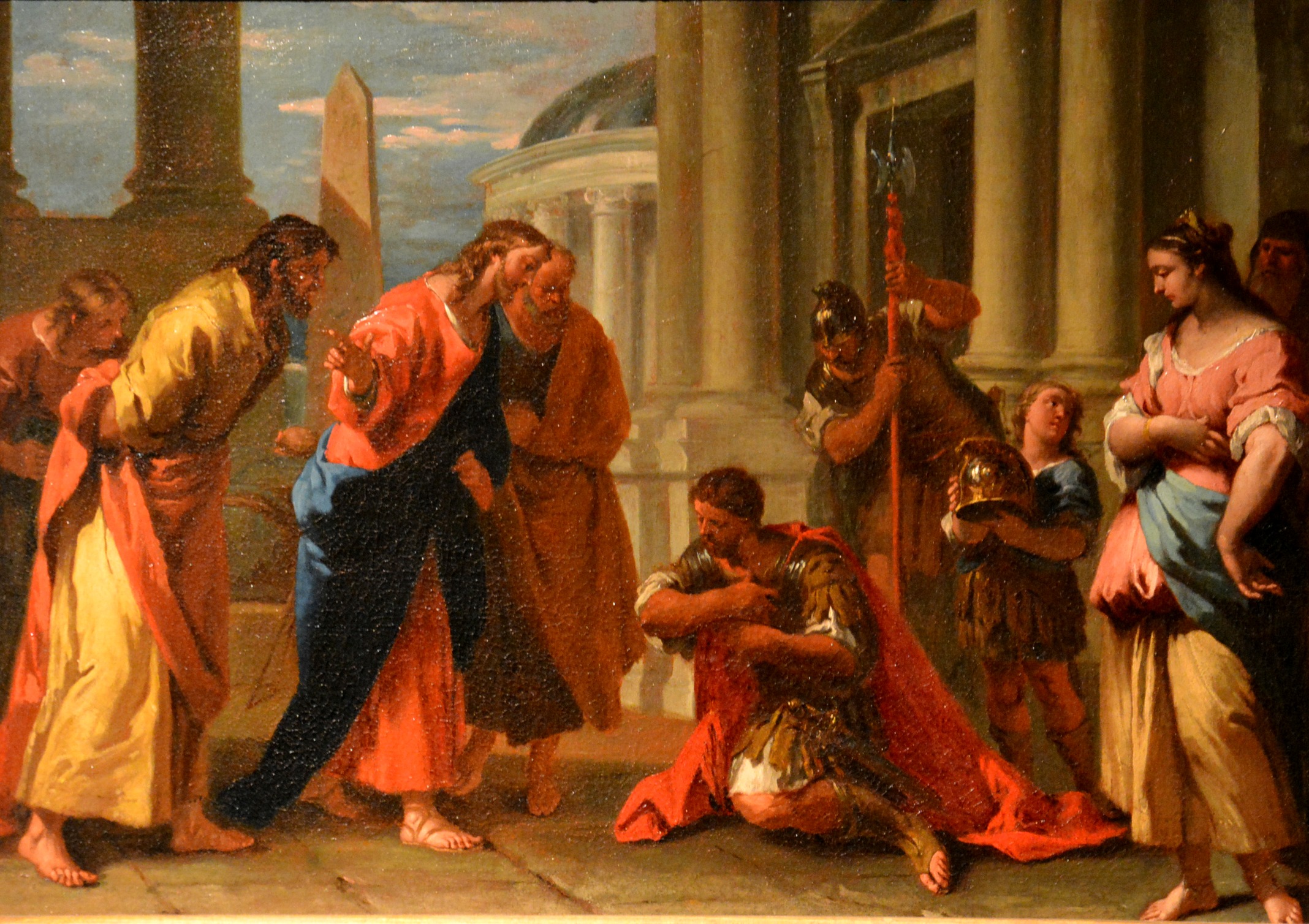
“When he had entered Capernaum, a centurion came forward to him, appealing to him, “Lord, my servant is lying paralyzed at home, suffering terribly.” And he said to him, “I will come and heal him.” But the centurion replied, “Lord, I am not worthy to have you come under my roof, but only say the word, and my servant will be healed. For I too am a man under authority, with soldiers under me. And I say to one, ‘Go,’ and he goes, and to another, ‘Come,’ and he comes, and to my servant, ‘Do this,’ and he does it.” When Jesus heard this, he marveled and said to those who followed him, “Truly, I tell you, with no one in Israel have I found such faith. I tell you, many will come from east and west and recline at table with Abraham, Isaac, and Jacob in the kingdom of heaven, while the sons of the kingdom will be thrown into the outer darkness. In that place there will be weeping and gnashing of teeth.” And to the centurion Jesus said, “Go; let it be done for you as you have believed.” And the servant was healed at that very moment.” (Matthew 8:5–13, ESV)
Do you ever take time and probe the depths of your faith? Sometimes, we are much more fragile than we would prefer to be. Let’s explore the story of a man whose faith surpassed many self-proclaimed Christians. The scene is set shortly after Jesus’ Sermon on the Mount in Capernaum, unveiling the cultural challenges of the time. The Jew-Gentile divide, often filled with hatred, and the intricate master-slave relationships where the master wielded absolute power over the slave paint a complex backdrop.
Our key to resolution lies in understanding the remarkable faith of the centurion, a Roman officer known for his honorable character. His interaction with Jesus during the healing of his gravely ill servant provides profound insights.
Consider the centurion’s humility. He recognized his unworthiness. Augustine wrote of the centurion by saying: “By declaring himself unworthy, he shewed himself worthy, not indeed into whose house, but into whose heart, Christ the Word of God should enter.“* (Matt. 5:3; Isa. 6).
He also recognized Christ’s authority over diseases, even those near death (Matt. 8:8-10). His faith was not bound by physical presence, starkly contrasting those questioning Jesus’ healing power. The centurion’s faith, labeled “great” by Jesus, was rooted in what he had heard about Jesus and demonstrated in his rejection of whatever he had in his past.
So, what does this mean for us? The centurion’s faith challenges us to reevaluate our own. Are we willing to humble ourselves, recognizing our unworthiness before the holy God? Do we acknowledge the authority of Christ, not just in our presence but in every aspect of our lives? The consequences are profound – abandonment awaits those outside of Christ, and it’s a sad reality that many reject God’s free grace (Jn. 3:18; 2 Thess. 1:9).
Ultimately, the centurion’s story is a lesson in faith, humility, and the inclusivity of God’s kingdom. May we, like the centurion, let our faith shine, rooted in a deep understanding of Christ’s authority and a humble recognition of our need for His grace.
~PW 🌮🛶
*Augustine S. Augustine, Bishop of Hippo, A.D. 396. Thomas Aquinas. (1841). Catena Aurea: Commentary on the Four Gospels, Collected out of the Works of the Fathers: St. Matthew (J. H. Newman, Ed.; Vol. 1, p. 305). John Henry Parker.
 Phillip W. Martin
Leave a comment